Why Profitable Service Businesses Go Bankrupt
You can have great margins and still run out of money. Here is why service businesses are vulnerable to the "profit paradox" and how to fix it.
On this page
It's the nightmare scenario for every agency owner, consultant, and IT service provider.
You had a record quarter. You closed three big deals. Your team is fully utilized. Your P&L shows a healthy 20% net margin. And yet, when you look at the bank account on payroll day, there isn't enough cash to cover the checks.
How can a business be profitable and bankrupt at the same time?
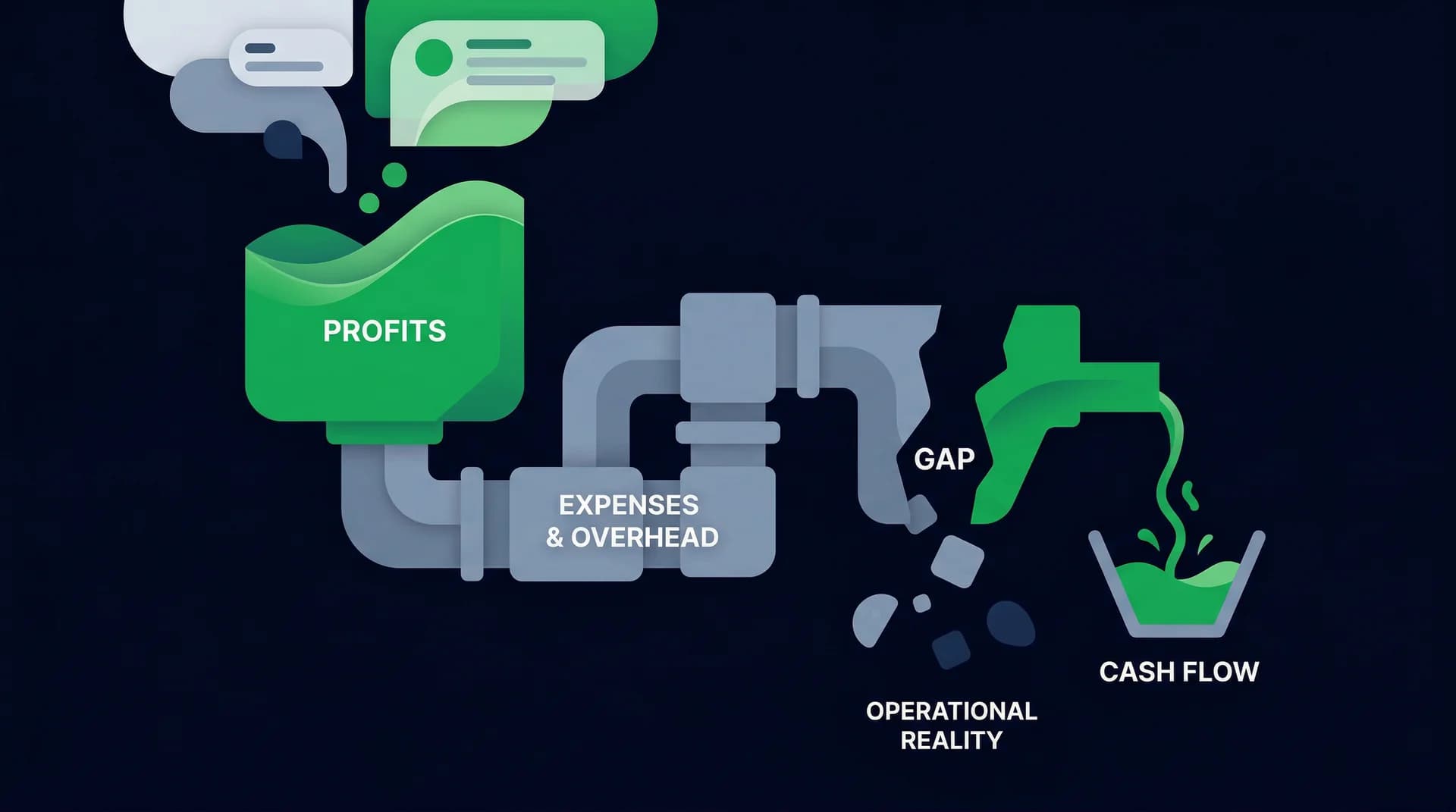
It happens more often than you think. According to SCORE, 82% of small businesses fail due to cash flow problems, not because they weren't profitable on paper. In the service industry, profit is an opinion. Cash is a fact. And the gap between the two - the time it takes to turn a booked hour into a dollar in the bank - is where profitable businesses go to die.
The Service Business Trap
Service businesses have a unique cash flow structure that makes them fragile.
Unlike a retailer who sells inventory instantly, a service business sells time. You pay your biggest expense - your people - every two weeks like clockwork. But you don't get paid for that time until much later.
Here is the math of a typical project:
- Month 1: You do the work. You pay your staff. Cash out: $50,000.
- Month 2: You finish the project and send the invoice. You pay your staff again. Cash out: $50,000.
- Month 3: The client receives the invoice (Net 30 terms). You pay your staff again. Cash out: $50,000.
- Month 4: The client pays the invoice (45 days later, realistically). Cash in: $200,000.
On paper, you made a $50,000 profit. In reality, you had to front $150,000 of your own cash just to survive until the check arrived. If you don't have that cash buffer, you are insolvent before the profit ever materializes.
You Are the Bank
When you offer payment terms, you are lending money. You are financing your client's operations with your own working capital.
Big clients love this. They push for Net 60 or Net 90 terms because it improves their cash flow at your expense. They are effectively borrowing money from you at 0% interest.
For a small service business, this is dangerous. You are not a bank. You don't have access to cheap capital. When you finance your clients, you are using your most expensive resource - your own equity or high-interest credit lines - to subsidize their balance sheet.
The Growth Penalty
The paradox gets worse when you grow.
Growth eats cash. To take on a bigger client, you need to hire more staff now. You need new software licenses now. You need a bigger office now.
But the revenue from that new client won't arrive for 90 days.
This is why fast-growing service firms often face the most severe cash crunches. Doubling your revenue usually means tripling your working capital requirement. If you grow too fast without fixing your collection cycle, you can literally grow yourself out of business.
Closing the Gap
You can't change the laws of math, but you can change the variables. To survive the profit paradox, you need to shorten the gap between work and payment.
1. Demand Deposits
Never start work without cash upfront. A 50% deposit isn't just about risk; it's about funding the project. It covers your payroll while you do the work.
2. Milestone Payments
Don't wait until the end of a 3-month project to invoice. Bill monthly, or bill on specific milestones (Design Approval, Beta Release). Keep the cash flowing in as the work goes out.
3. Automate Collections
The biggest preventable cause of the cash gap is slow collections. If your terms are Net 30, but your average Days Sales Outstanding (DSO) is 55 days, that extra 25 days is purely administrative slack.
It's the invoice that wasn't sent immediately. It's the reminder that wasn't sent until the following week. It's the "check is in the mail" excuse that wasn't challenged.
This is where automation saves you.
Dunwise acts as your relentless accounts receivable department. Our AI voice agent calls on overdue invoices the day they go late. It doesn't get busy. It doesn't feel awkward asking for money. It just executes the process.
By tightening your collection cycle from 55 days to 35 days, you permanently unlock 20 days of cash flow. For a $2M agency, that's over $100,000 in cash that is now in your bank account instead of your client's.
Profit is nice. But cash is oxygen. Don't let your business suffocate while waiting for a check that's "in the mail."