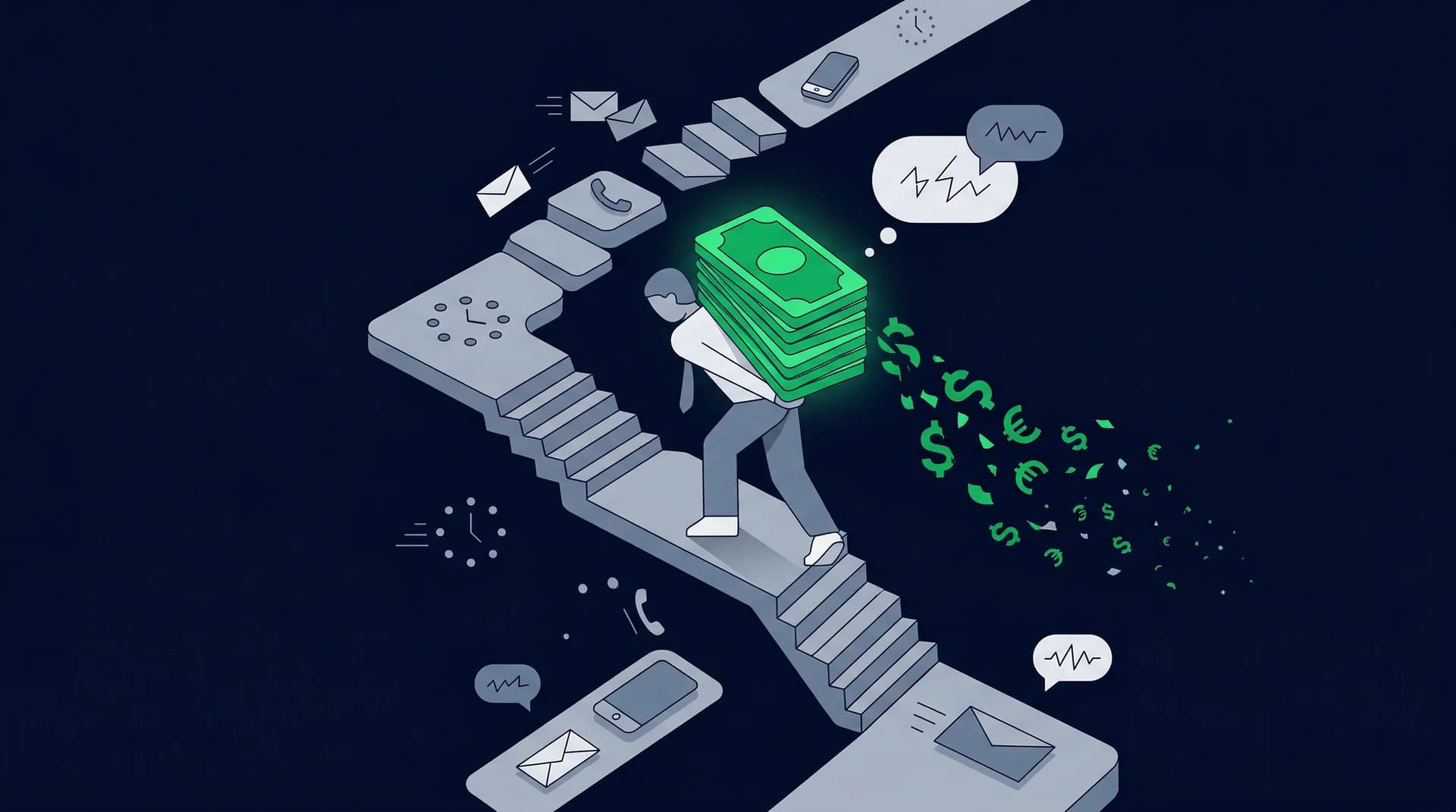
The Real Cost of Chasing Late Payments
Late payments cost the average company tens of thousands of dollars a year. The real damage isn't the invoice. It's the hours, the stress, and the growth you're missing.
On this page
Research from PNC Bank shows that 82% of small business failures are due to cash flow problems. Late payments aren't just an inconvenience; they're a primary driver of business failure.
You finally collected that overdue invoice. Four thousand euros, 47 days late. You should feel relieved. Instead you feel exhausted, because getting here took six emails, two phone calls, a dispute about the delivery date, and a week of waiting after the customer promised to "process it Friday."
The invoice is paid. But the cost of collecting it? Nobody tracks that.
The hidden line item that doesn't show up on your P&L
Late payments cost the average company tens of thousands of dollars per year in direct and indirect expenses. That's not the amount owed. That's the cost of dealing with the problem: the time spent chasing, the credit you take on to bridge gaps, the growth you defer because cash is stuck in receivables.
For most SMBs, this number is invisible. It doesn't appear as a line item. It's spread across payroll hours, interest on credit lines, and opportunities that quietly never happened. But when researchers add it all up, the figure is consistent: tens of thousands of dollars per year, per company. For some businesses, it exceeds six figures.
Where the time goes
About one in five small businesses dedicate staff time specifically to chasing payments. On average, that's dozens of hours per year. Some businesses have it worse: 12% employ at least one person whose primary job is collecting money that should have arrived on time.
Think about what dozens of hours means for a company with 5 to 15 employees. That's more than two full working weeks. Weeks that could go toward client work, sales, hiring, product development. Instead, they go toward sending reminders, making calls, reconciling partial payments, and re-sending invoices that someone claims they never received.
And that figure is conservative. It counts structured collection activities. It doesn't count the owner checking their bank account every morning, the mental energy spent deciding whether to call a client, or the 20 minutes lost to frustration when you see the same invoice sitting unpaid for the third week in a row.
The credit card spiral
When cash doesn't arrive on time, you still have to pay your own bills. Materials, rent, payroll, suppliers. The money has to come from somewhere.
Businesses heavily affected by late payments are significantly more likely to have increased their reliance on credit cards over the past year. They use loans at nearly double the rate (21% vs 11%) and lines of credit at 50% higher rates (31% vs 21%) compared to businesses without significant payment delays.
This creates a compounding problem. You're not just losing the time value of the invoice. You're paying interest to cover the gap that the invoice created. The customer eventually pays in full, but you've already spent money borrowing against their lateness. That interest cost never comes back.
For businesses with 90-day payment terms, the picture is stark: they charge 40% of their monthly expenses to credit cards, compared to 33% for businesses with immediate terms. Every extra day an invoice sits unpaid is a day you're financing someone else's cash flow problem.
The growth you can't see
The vast majority of businesses say late payments have set back their long-term growth goals. That sounds abstract until you see what it looks like in practice.
The majority have had to abandon expansion plans. Over half have postponed purchasing equipment or inventory. Businesses dealing with significant payment delays are 1.3 times more likely to report difficulty hiring skilled workers, not because they can't find candidates, but because they can't commit to the payroll.
These aren't dramatic collapses. They're quiet stalls. The hire you wanted to make in Q2 gets pushed to Q4. The marketing budget gets cut by 30%. The new service line stays on the whiteboard. You tell yourself you'll do it next quarter, when cash flow is better. Cash flow is never better, because the late payments don't stop.
The cost nobody talks about
The majority of small business owners report stress, anxiety, or depression linked directly to cash flow problems caused by late payments. 41% say it affects their life outside of work, causing insomnia, strained relationships, and difficulty being present with their families.
Of business owners who've dealt with overdue invoices, 25% held off on reinvesting in their own business. 17% couldn't buy household items like groceries. 12% had to take on personal debt.
These aren't statistics about failing businesses. These are statistics about business owners who deliver good work, invoice for it, and then wait. The work was done. The value was delivered. The only thing missing is the payment, and the weight of chasing it falls entirely on the person who already did the hard part.
Why "just follow up" isn't a solution
The standard advice is straightforward. Send reminders. Make calls. Be consistent. The advice isn't wrong. The problem is that it assumes you have unlimited time and emotional bandwidth to execute it perfectly across every single invoice.
More than half of business owners forfeit late payments up to ten times per year just to avoid the time and cost of chasing them. Read that again. Half of businesses are walking away from money they're owed because the process of collecting it costs more than they're willing to spend.
That's the real failure. Not that businesses don't know how to follow up. It's that the follow-up doesn't scale. You can be disciplined about your top ten invoices. But the eleventh, the twelfth, the small ones, the ones from clients you like? Those slip.
What it looks like when the system handles it
Dunwise was built to eliminate the costs described above. Not the invoice amounts. You're already owed those. The other costs. The ones that don't show up on your P&L.
Our AI voice agent handles overdue follow-up calls for every invoice, at every stage. That means the staff hours redirected to client work. The credit line that stays unused because invoices get resolved before you need to bridge the gap. The expansion plan that stays on schedule because your cash flow is predictable.
The calls happen on time, every time, regardless of how busy your week is. The conversations adapt to what the customer says. And every call produces structured data you can actually act on: payment commitments, dispute reasons, updated contact information. Your AR stops being a problem you manage and becomes a process that runs.
If you want to see how it works, book a demo. Your invoices are already doing the hard part of sitting there. Let's stop making you do the hard part of chasing them.