How Much Should Accounts Receivable Software Cost?
AR software runs $80-650/user/month, but your team still makes every call. See what you actually get for that price and which pricing models deliver more value.
On this page
Most accounts receivable software costs between $80 and $650 per user per month. For a team of three, that is $2,880 to $23,400 per year. And your staff still has to pick up the phone.
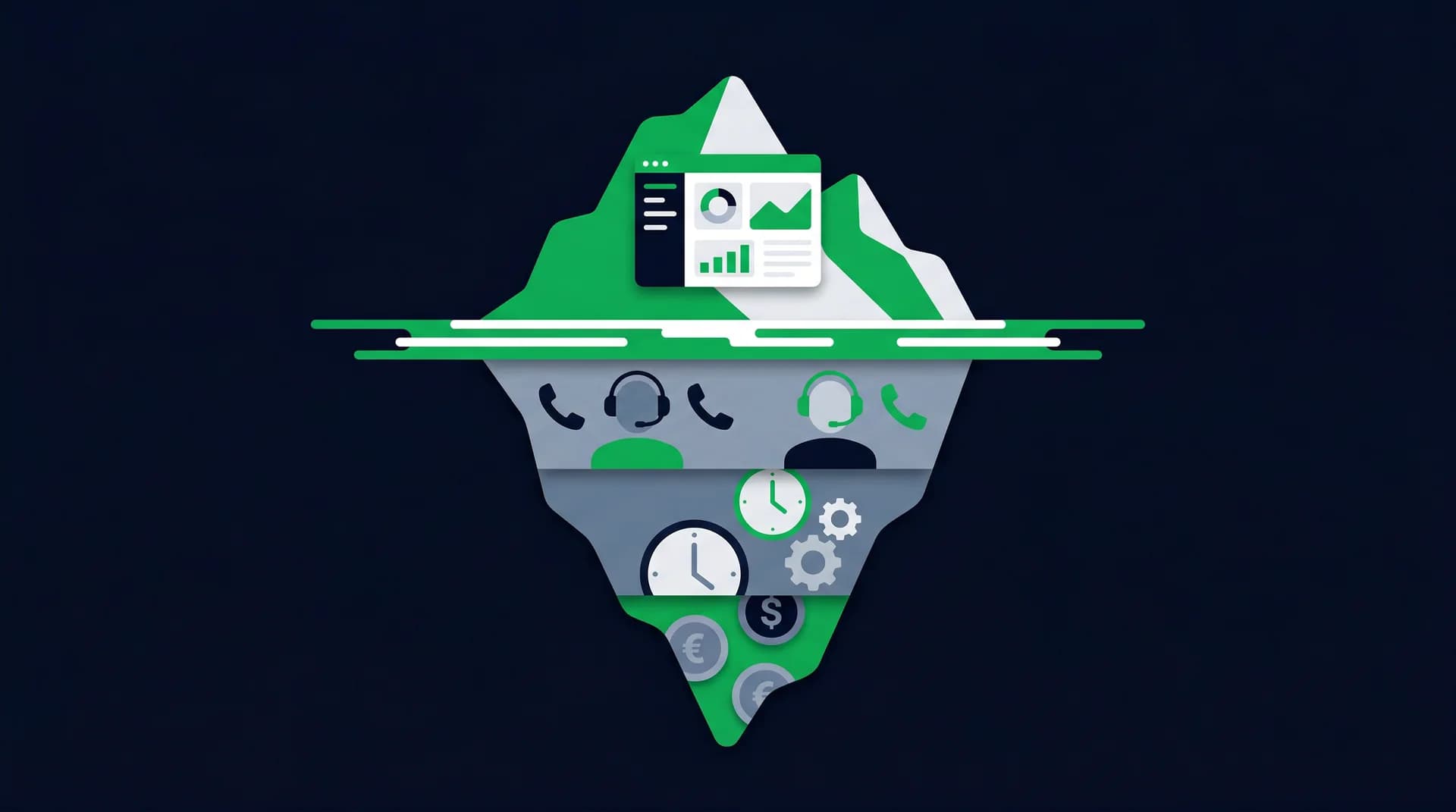
That is the part nobody mentions on the pricing page. You are paying for software that automates email reminders and builds dashboards, but the hardest part of collections, the actual phone calls, stays on your team's desk.
This article breaks down what AR software actually costs, what you get (and don't get) at each price point, and whether there is a better way to align cost with results.
The accounts receivable software pricing landscape
AR platforms overwhelmingly use per-seat licensing. You pay a monthly fee for each person on your team who needs access.
Here is what the market looks like in 2026:
| Tier | Price range | Examples | What you get |
|---|---|---|---|
| Entry-level | $9-99/month | Small-business invoicing add-ons | Basic reminders, simple aging reports |
| Mid-market | $80-200/user/month | Chaser, Upflow, Gaviti | Email sequences, dashboards, some workflow automation |
| Enterprise | $300-650+/user/month | HighRadius, Billtrust, Versapay | Full O2C suite, AI-drafted templates, customer portals, integrations |
Some platforms, like Gaviti, charge per number of customers invoiced rather than per seat. For more insights on AR collection performance, see these accounts receivable cash collection statistics. Others, like Chaser, bill by invoice volume ($49-369/month depending on the number of invoices chased). Enterprise platforms like HighRadius often start at $50,000 to $150,000 per year with custom quoting.
The per-seat model dominates the mid-market. If your AR team has three people, that mid-range tier alone puts you at $2,880 to $7,200 per year before you account for setup fees, integrations, or the premium modules that are always sold separately.
What you get for that price
At the mid-market tier ($80-200/user/month), the typical AR platform gives you:
- Automated email sequences. The software sends reminders on a schedule: before the due date, on the due date, and at intervals after.
- Aging dashboards. Visual breakdowns of your receivables by 30, 60, 90+ days.
- Reporting. DSO tracking, collector performance metrics, payment prediction scores.
- Customer portals. Some platforms let your customers view and pay invoices online.
- AI-drafted templates. A handful of newer platforms use AI to suggest email wording based on invoice age and customer history.
That is real value for teams drowning in spreadsheets. Moving from manual tracking to automated workflows can save hours per week.
But look at what is missing from that list: phone calls.
Not a single mainstream AR platform actually calls your customers. They automate the email. They build the dashboard. They even tell you which accounts need a call. But when it is time to pick up the phone, that is still your job.
The hidden cost sitting on top of the subscription
This is where the accounts receivable software cost calculation falls apart.
You are paying $200/user/month for three seats. That is $7,200 a year. Your email sequences are running. Your dashboards look great.
But 65% of mid-sized businesses still spend an average of 14 hours per week on administrative tasks related to collecting payments. That includes the calls your software cannot make: the conversation where the customer explains they never received the invoice, the negotiation over a partial payment plan, the follow-up to get a verbal commitment honored.
At 14 hours per week, that is 728 hours per year. If your AR staff costs $35/hour fully loaded, the labor cost of manual follow-up is roughly $25,480 per year.
Add the software subscription: $7,200 + $25,480 = $32,680 per year.
For that money, you get email reminders (which most debtors ignore once invoices pass 30 days) and dashboards that tell you what you already know: these invoices are late. The software handles the easy part. Your team still does the hard part.
Alternative pricing models worth considering
Not every AR platform charges per seat. Here are the three main alternatives:
Per-invoice or per-volume pricing. Chaser charges based on how many invoices you chase per month ($49-369/month). This model works if your invoice count is predictable, but costs can spike during busy periods.
Percentage of recovered revenue. Collection agencies use this model (typically 20-35% of collected amounts). It aligns cost with outcome, but the percentage is steep and the agency takes over your customer relationship.
Per-call pricing. This is the model Dunwise uses. Instead of paying for software seats your team uses to send emails, you pay per call that the AI agent actually makes. No calls, no cost. The AI agent handles the entire conversation: identifying the reason for non-payment, negotiating payment commitments, sending invoice links and payment links via SMS during the call, and escalating disputes to your team.
Per-call pricing changes what "accounts receivable software cost" actually means. Instead of paying for access to a tool, you pay for work getting done. The cost scales with your overdue invoice volume, not with your headcount. And because the agent handles the phone calls, you eliminate the 14 hours per week your team currently spends chasing.
What to look for when comparing AR software pricing
Before signing an annual contract, ask these questions:
Does the price include the full workflow? Most platforms automate email and stop there. Ask specifically whether the software handles phone-based follow-up, or whether your team is expected to make those calls manually. If the platform only does email, you are paying for half a solution.
Are there hidden fees? Setup fees, integration fees, minimum commitments, per-user add-ons for "premium" features like analytics or call recording. The sticker price on the pricing page is rarely the real price.
Does cost align with results? Per-seat pricing charges you the same whether you collect 10% more or 50% more. Look for models where the vendor's cost scales with the value they deliver. If you are not getting results, you should not be paying the same amount.
What happens to the phone calls? This is the question that separates AR software from AR automation. If the answer is "your team makes them," then the software is a reporting tool with email automation, not a collections solution. You are still doing the work that moves the needle. Phone calls are where payment commitments actually happen and where disputes get surfaced.
The bottom line on accounts receivable software cost
Traditional AR software costs $80-650 per user per month and automates email reminders. That is a real improvement over spreadsheets. But it leaves the most expensive and most effective part of collections, the phone call, entirely on your team.
When you add the labor cost of manual phone follow-up to the subscription price, the total cost of collections for a mid-sized team can exceed $30,000 per year. Most of that is not the software. It is the work the software does not do.
Per-call pricing models like the one Dunwise uses flip this equation. You pay for outcomes (calls made, commitments captured, disputes surfaced), not for dashboard access. If you want to see what per-call AR automation actually looks like, try the demo or see how Dunwise compares to traditional AR platforms.