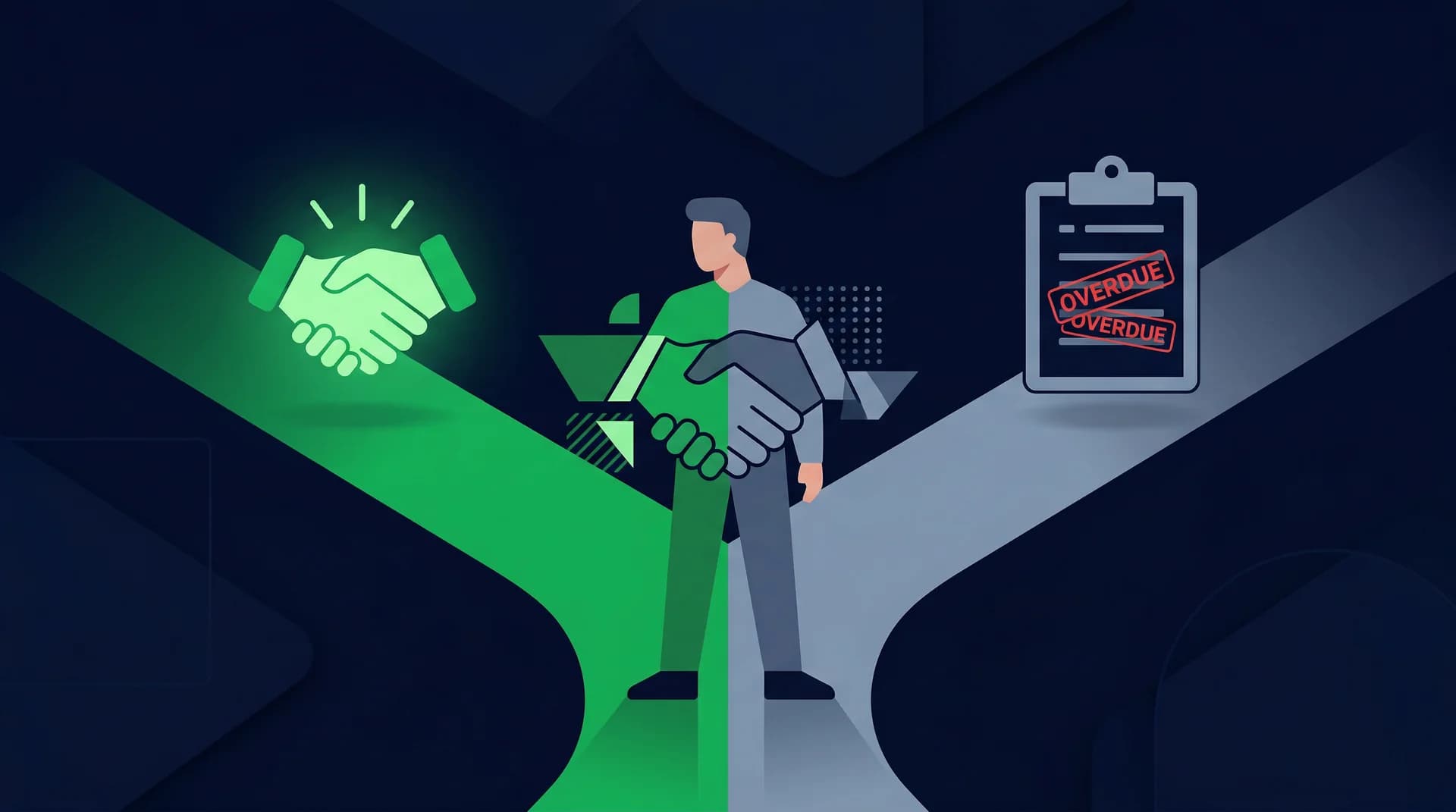
Why Business Owners Should Not Make Collection Calls
When the owner calls for money, the relationship changes. Discover the "Good Cop, Bad Cop" strategy that gets you paid without awkwardness.
On this page
Late payments are a leading cause of cash flow problems that cause small businesses to fail. When you're chasing payments yourself, you're not just losing time; you're risking the very survival of your company.
You have a great relationship with your client. You solved their problem. You delivered on time. You might even have grabbed a beer with them after the project launch.
Now the invoice is 45 days overdue.
You know you need to call. But the phone feels like it weighs a thousand pounds. Because you know that the moment you ask "when can we expect payment?", the dynamic shifts. You stop being the trusted partner and start being the debt collector.
This is the "Owner's Trap." In small businesses, the person who closes the deal is often the person who has to chase the check. And that dual role is one of the biggest reasons why SMBs struggle with cash flow.
The Psychology of the "Good Cop"
In any negotiation, relationships matter. As the business owner or lead account manager, your role is to be the "Good Cop." You are the problem solver. You are the one who says "yes" to scope requests, who finds ways to make things work, who builds the long-term vision.
Collection calls are inherently "Bad Cop" work. They require saying "no." They require enforcing boundaries, referencing contracts, and applying pressure.
When you try to play both roles, you undermine both.
If you are too aggressive on the collection call, you damage the relationship you built during the sale. The client feels awkward, defensive, or resentful.
If you are too friendly (to protect the relationship), you undermine the collection effort. You accept vague excuses like "I'll look into it" because you don't want to create tension. The client learns that your payment terms are suggestions, not rules.
Why Outsourcing the "Bad Cop" Works
Large companies solved this decades ago. The sales rep never asks for the check. The Accounts Receivable department does.
When a dedicated AR person (or system) makes the call, it depersonalizes the request. It becomes a process, not a confrontation.
- The Owner says: "I'm so excited about Phase 2 of the project. Let's get that kicked off."
- The AR System says: "This is a reminder that invoice #1024 is overdue. Per our policy, we need to resolve this before new work begins."
This separation allows the owner to remain the ally. When the client complains to you about the dunning call, you can say: "I know, the finance team is strict about those deadlines. Let's get it sorted so we can focus on the work."
You are now on the same side of the table as the client, helping them solve an administrative problem, rather than sitting across from them demanding money.
The Cost of Doing It Yourself
Beyond the psychological friction, there is a hard cost to owner-led collections.
The average SMB owner spends hours every week on financial administration. That is nearly two full days. Every hour you spend chasing a $500 invoice is an hour you are not selling a $50,000 project.
Your hourly rate as a founder or manager is effectively the highest in the company. Using that expensive time to perform a task that an entry-level clerk (or a piece of software) could do is bad math.
But the biggest cost is the opportunity cost of the calls you don't make. Because the calls are uncomfortable, you put them off. You wait until day 60 instead of day 30. You send an email instead of calling. You let the "good" clients slide.
That hesitation creates a permanent drag on your cash flow.
The AI Solution: Your Virtual "Bad Cop"
For most SMBs, hiring a dedicated AR clerk isn't feasible. You don't have enough volume to justify a full-time salary.
This is where AI voice agents change the equation. Dunwise acts as your dedicated Accounts Receivable department. It plays the "Bad Cop" role (professionally, of course) so you don't have to.
When Dunwise calls your client:
- It is persistent: It doesn't feel awkward about calling three times in two weeks. It just follows the schedule.
- It is professional: It treats the overdue invoice as a factual administrative matter, not a personal favor.
- It protects you: It allows you to stay in the visionary, relationship-building role.
The next time a client is late, don't pick up the phone yourself. Let the system handle the process, so you can handle the relationship.