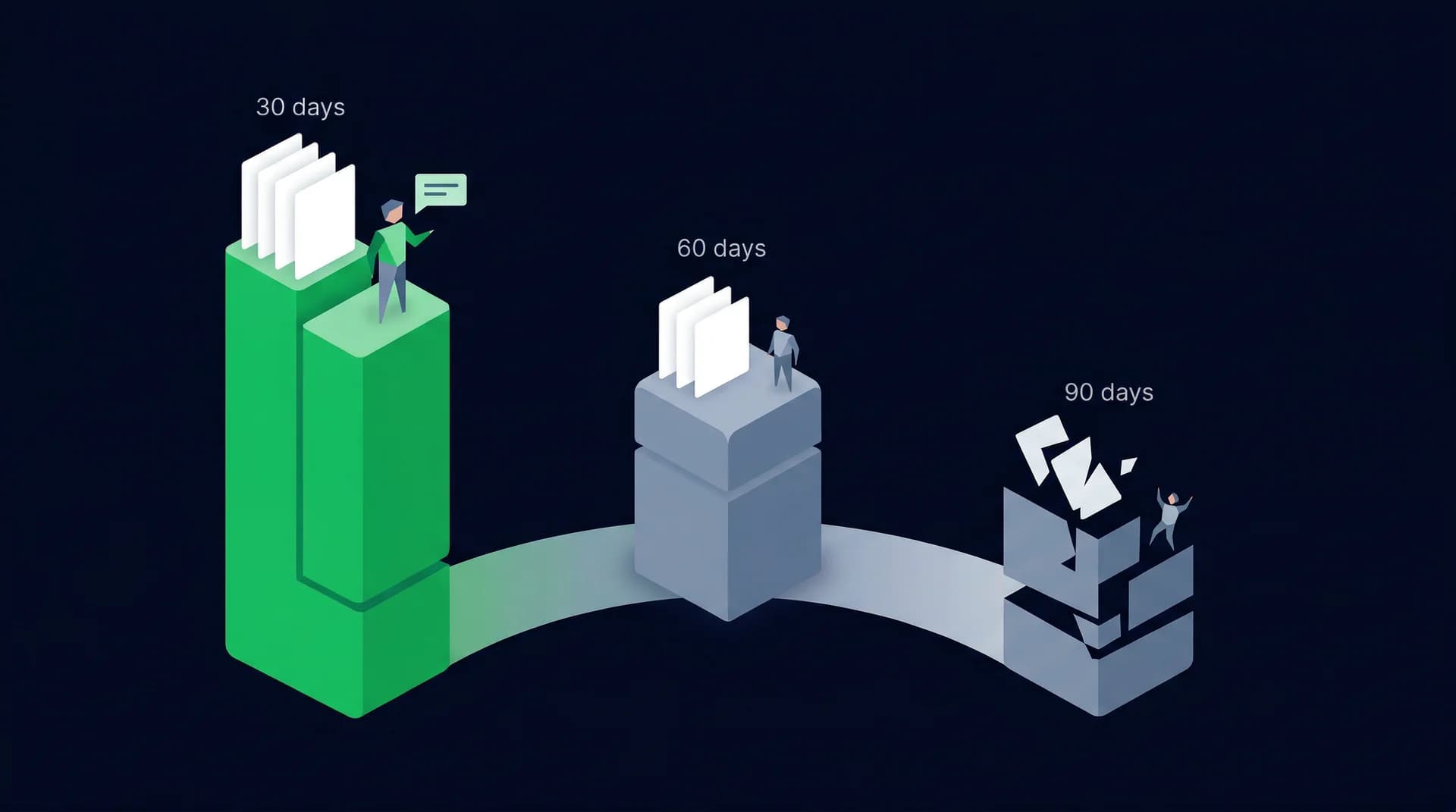
What Happens to Unpaid Invoices After 30, 60, and 90 Days
The majority of small businesses have invoices over 90 days overdue. Your odds of collecting drop at every stage. Here's what to do at 30, 60, and 90 days.
On this page
You invoice a client. Net 30. Day 31 rolls around and nothing. You send a polite email. Silence. By day 45 you're annoyed. By day 60 you're wondering if you'll ever see the money. By day 90 you're thinking about writing it off.
This pattern plays out constantly. The majority of small businesses currently have invoices that are more than 90 days overdue. The problem isn't that these businesses don't care about the money. It's that most of them have no structured process for what to do when an invoice goes unpaid.
So let's walk through it. What actually happens at each aging stage, what it means for your odds of getting paid, and when you should start worrying.
The first 30 days: probably fine
When an invoice is 1 to 30 days overdue, you're in the "benefit of the doubt" zone. The standard write-off rate for receivables in this window is about 1%. Almost everyone pays eventually.
Most late payments in this stage are genuinely accidental. Someone forgot. The invoice got buried in an inbox. The person who approves payments was on vacation. A simple reminder usually fixes it.
The risk here isn't losing the money. It's losing momentum. If your first follow-up happens at day 25 instead of day 7, you've given the customer three extra weeks to forget about you. And that pattern compounds.
Most B2B transactions use Net 30 terms, but the average invoice is paid well past the deadline. That gap of 8 days might sound small, but across a portfolio of invoices, it translates to thousands of dollars sitting in someone else's bank account instead of yours.
What you should do in this window: send a reminder within the first week. Keep it light and assume good intent. A quick "hey, this invoice is coming up on its due date" is enough. If you've already passed the due date, follow up right away. Don't wait for it to "feel" overdue enough.
Days 31 to 60: the danger zone
This is where things get real. The industry standard write-off rate jumps to roughly one in ten for invoices in the 31-to-60-day bucket. One in ten invoices that reach this stage never gets paid.
Nearly half of businesses have invoices overdue by more than 30 days. If that describes you, you're not behind. But you need to be doing something different than what you did in the first 30 days.
At this point, the friendly email reminder strategy stops working. If a customer ignored your first two emails, a third one isn't going to change their mind. The reasons invoices stay unpaid past 30 days tend to fall into a few categories:
They're disputing something but haven't told you. Maybe the amount is wrong. Maybe they think the work wasn't completed. Maybe there's a contract disagreement. You won't know unless you have an actual conversation.
They're having cash flow problems of their own. This is more common than most people realize, especially in industries with long payment chains like construction or staffing. They might want to pay you but genuinely can't right now.
They're deprioritizing you. If they owe money to multiple vendors, the one who follows up most consistently gets paid first. That's just how it works.
What you should do: pick up the phone. Phone-based collection is far more effective at this stage. You need a real conversation to understand why the payment hasn't happened and to get a specific commitment. "I'll pay soon" isn't a commitment. "I'll pay the full amount by February 15th" is.
Days 61 to 90: last chance
The write-off rate for invoices past 60 days climbs to roughly a quarter. A significant share of receivables that reach this point become bad debt.
If an invoice has been outstanding for two months and you haven't been able to reach the customer or get a commitment, you're running out of options fast. This is the "final notice" stage. The conversation shifts from "just checking in" to "we need to resolve this today."
In Europe, the EU Late Payment Directive entitles you to charge statutory interest and claim a fixed recovery fee on overdue B2B invoices. The exact rates depend on your jurisdiction and current central bank rates. Most businesses don't know this, and even fewer actually claim it. But mentioning these charges in your communications signals that you're serious.
In the US, there's no federal statutory interest rate for B2B invoices, but your contract terms and state law may give you similar weight. The point is: by day 60, you should be referencing consequences, not just sending reminders.
What you should do: send a formal final notice. Make it clear that the next step is escalation, whether that's a collection agency, legal action, or suspending the business relationship. And give a specific deadline. "Please remit payment by [date] or we will begin escalation proceedings" is much more effective than another "friendly reminder."
Past 90 days: recovery mode
Once an invoice crosses 90 days, you're in a different category entirely. Most businesses treat this as the threshold for collections referral.
Collection agencies charge a large percentage of whatever they recover. That's painful, but it's better than zero. And in healthcare, the numbers are even worse: only a fraction of balances past 90 days are successfully recovered.
The real question at this stage isn't "should I send to collections?" It's "how did this invoice get to 90 days in the first place?"
In almost every case, the answer is the same: inconsistent follow-up. Someone sent the invoice, maybe sent one or two email reminders, and then got busy with other work. The invoice quietly aged while nobody was watching.
The pattern that actually prevents write-offs
Look at the data across all stages and one thing becomes clear: the businesses that lose the least money to bad debt are the ones that follow up early, often, and through multiple channels.
The best performers in accounts receivable keep bad debt near zero. The average is several percent. The difference isn't better customers. It's better follow-up.
That means a reminder within the first week. A phone call by day 15 if the email didn't work. A firm conversation at day 30. A final notice at day 60. And escalation at day 90. Every single time, for every single invoice.
The reason most businesses can't maintain this cadence is simple: it's too much work. An AR clerk can make a limited number of calls per day. If you have 200 overdue invoices, the math doesn't work. So the smaller invoices get ignored, and they're the ones that age into write-offs.
What this means for your business
The takeaway isn't complicated. Every invoice should get consistent follow-up at every stage. Not just the big ones. Not just the ones you remember to check on. All of them.
At Dunwise, this is exactly what we built our AI voice agent to do. It calls every overdue customer on schedule, adapts the tone to the aging stage (friendly at 7 days, firm at 60), and captures structured outcomes from every conversation. Promise-to-pay dates, dispute reasons, payment arrangements. Your AR dashboard fills itself in.
The result: invoices stop quietly aging past 30 days because every one of them gets a phone call before it has the chance.
If you want to see what that looks like for your business, book a demo. The invoices that end up as bad debt are almost always the ones nobody called about in time.